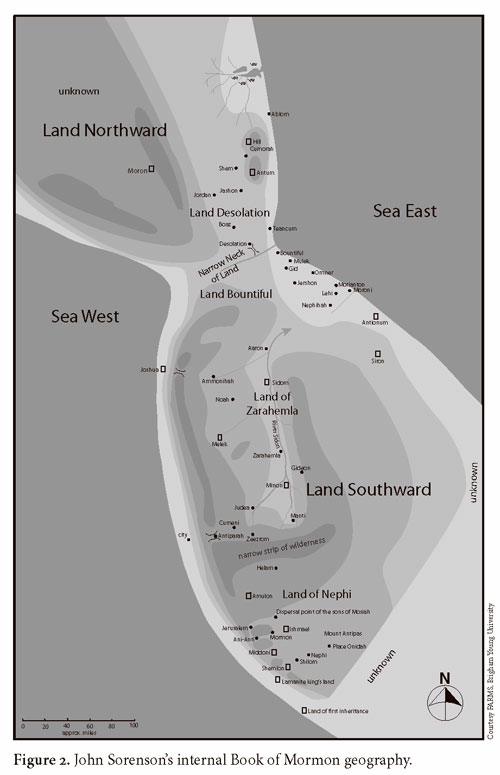
John Sorenson – “Mormon’s Codex: An Ancient American Book” (See a video further down the page.)
“I admit that my own model was tainted by preconceptions” (John Sorenson, The Geography of Book of Mormon Events, pp. 209-210).
The following example proves Sorenson did not overcome his confessed preconceptions:
“An isthmus, ‘the place where the sea divides the land’ (Ether 10:20), connected the two major blocks of land. Alma 22:32 pictures ‘the land northward and the land southward’ joined by ‘a small neck of land between.’ In Alma 63:5 and elsewhere it is labeled the ‘narrow neck.’ This isthmus had sea to the west and to the east (see Alma 50:34; 63:5; Helaman 4:7). These seas had to be the Pacific and Atlantic Oceans, respectively, because Lehi arrived from the Old World across the west sea (see Alma 22:28), and the party that brought Mulek from the land of Judah came ‘across the great waters’ (Omni 1:16) to the ‘borders by the east sea.’ The city of Mulek was located in that area and was presumably near the location where they first settled (see Alma 51:26)” (Source: Mormon’s Map/Overall Configuration).
The presumptions exhibited were:
- The seas had to be the Pacific and Atlantic Oceans
- Lehi arrived from the Old World across the West Sea
- The party that brought Mulek from the land of Judah came “across the great waters” (Omni 1:16) to the “borders by the East Sea”
Anyone who reads those passages knows that such conclusions are not justified. Yet there they are, unquestioned by hundreds for decades, thanks to John Sorenson. On our Great Sea page, we detail the name of the ocean each group crossed (including the Jaredites), and the term “West Sea” or “East Sea” is never used. The fact that the ocean they crossed was not mentioned after they arrived is proof that it did not border Book of Mormon lands.
“How wide was this narrow neck? One historical anecdote makes clear that it was wide enough that a party passing through it could not detect seas on either side. Limhi’s explorers traveled northward from the land of Nephi trying to locate Zarahemla but wandered on through the narrow neck. When they returned home they thought they had been in the land southward the whole time.” -Sorenson
The “lack of evidence is not evidence of lack.” Being unfamiliar with the Land Northward and the Narrow Neck it meant nothing to them, so they did not mention it. Only after arriving in Zarahemla would it be explained, after the found records were translated.
“…it was well-known among his people that it was ‘the distance of a day and a half’s journey for a Nephite’ across the isthmus (Alma 22:32).” -Sorenson
Again, that’s not what the text says. The land of Bountiful and Desolation was that wide, not the Narrow Neck. Thanks to John Sorenson, hundreds have been misled on this for decades (details are on Narrow Passage). And so it goes all throughout Sorenson’s work, interjecting his bias, as he already admitted above, whether misinterpreting a cold and flu season as malaria or a single reference to heat as the Tropics. All in all, Sorenson ignores the reason anyone should be seriously studying geography—land promises (i.e., “Spiritual Geography”):
“One of Sorenson’s few references to the ‘promised land’ occurs in his comment on Ether 6:12 in A Source Book, 307″ (Earl M. Wunderli, “Critique of a Limited Geography for Book of Mormon Events,” Dialogue, vol. 35, no. 3, FAll 2002 p. 182, fn. 47).
Mesotheorists are unable to claim fulfilled land promises in Mesoamerica (see Hauck’s attempt). See Spiritual Geography for a list of those promises.
“Without rehearsing the twists and turns of my thinking and accommodation to the scientific facts, I simply say that the Book of Mormon is an ancient Mesoamerican record, derived ultimately from a codex or native book written in the fourth and fifth centuries AD. Over 400 elements of the book’s text are written in a manner and display content that cannot be accounted for except by supposing its Mesoamerican origin. Of all the theories of origin for the Book, the only acceptable explanation for how it came to be published in English in 1830 is that offered by Joseph Smith. No nineteenth-century person (nor any twentieth-century individual) could have known enough about ancient Mesoamerican civilization to account for the depth and breadth of the ‘Mesoamericanisms’ the scripture contains.” Reference
“I’m doing my last book,’ Sorenson said. ‘At age 85 it ought to be my last.’ The book is ‘Mormon’s Codex: An Ancient American Book.’ Sorenson said the book will cover ‘at least 420 points at which the Book of Mormon has Mesoamerican material in it, material that could not possibly have been included by anyone except an ancient Mesoamerican writer of the fourth century A.D.’ He said there was no publisher for the book yet, but hoped to find one soon.
‘Finally there will be an answer to those who say, There’s no archeological evidence of the Book of Mormon. There will be hundreds of pages of it in spades.’ ‘It is what it is,’ Sorenson said. ‘It is exactly what it said it is.'” Reference